Why Measure Team Performance?
The gap between "we're working well" as a feeling and "we're actually working well" as a fact is closed by data. Without data, you can't know why a specific technician is slow, where service times are stretching, or which fault types are recurring.
A company that can't measure performance can't manage performance.
---
1. Gain Visibility with Digital Work Orders
With paper work order systems, managers have zero visibility into the field. Who is where, which job is done, which is stuck — all unknown.
With a digital work order system:
- Open work orders are listed in real time.
- Technicians' daily workloads are visible on the Kanban board.
- Overdue or unresolved work orders trigger automatic alerts.
- Completed jobs are recorded along with their duration.
This visibility alone delivers an average 20-25% efficiency gain — because the manager can see problems in real time and intervene.
---
2. Eliminate Wasted Trips with Smart Technician Assignment
Wrong assignment costs the technician, the customer, and the company. Common mistakes:
- Sending the "available" technician instead of the nearest one — unnecessary travel cost.
- Assigning a technician without the right expertise — a second visit becomes unavoidable.
- Giving two jobs in the same area to different technicians — route waste.
With smart assignment, daily routes stay compact, expertise is matched, and the number of completed jobs per vehicle per day increases.
---
3. Save Time in the Field with the Mobile App
A significant portion of the time a technician spends on the job is consumed not by technical work but by bureaucracy: filling out forms, calling the office, checking part availability, collecting signatures.
The mobile app removes these friction points:
- Work order details (customer info, device history) are ready in the app.
- Parts stock queries are instant.
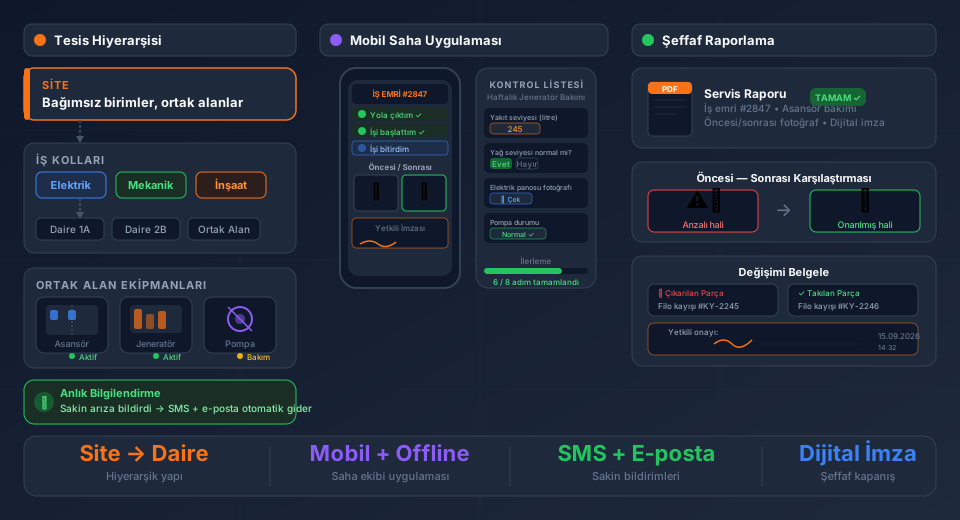
- Photo uploads, form completion, and customer signature in a single flow.
- No need to call the office: in-app messaging.
45-60 minutes saved per technician per day, multiplied by team size, means significant capacity gain.
---
4. Report Recurring Faults and Find Root Causes
Receiving a third call from the same customer for the same device is both costly and damaging to your reputation. There are usually two causes:
- The problem was resolved superficially — root cause not identified.
- The device model or batch carries a common manufacturing defect.
With the reporting module, recurring faults can be automatically flagged and systematically analyzed. This analysis both improves service quality and provides strong data for manufacturer feedback.
---
5. Manage Performance with KPIs
You can't manage what you can't measure. Key performance indicators for field service teams:
| KPI | Target |
|-----|--------|
| First-Time Fix Rate (FCR) | > 85% |
| Average service completion time | < 4 hours |
| Customer satisfaction score | > 4.5 / 5 |
| Daily completed work orders | > 4 jobs/technician |
| Repeat visit rate | < 10% |
Companies that track these metrics weekly spot deviations early and take corrective action in time.
---
Conclusion
Field service performance doesn't improve on its own — it must be measured, made visible, and systematically managed. Digital tools make this management both possible and scalable.
How to measure field service team performance with FSM software →
MÇ
Metin Çelik
Founder & CEO — FieldCo / MOBIM Software
Metin Çelik founded MOBIM Software in 2002 and has spent 24 years in field service management, helping 350+ companies digitalise their field operations.